25 August 2026 · CineFood Italia Editorial Team
The Godfather Filming Locations in Sicily
Where The Godfather was filmed in Sicily: Savoca, Forza d'Agrò and Al Pacino's Bar Vitelli. A complete guide to the film's real locations.
No film has made Sicily more famous than The Godfather. And yet the town that gives the Corleone family its name, Corleone itself, never appears on screen: Francis Ford Coppola filmed elsewhere, in two villages near Messina that had stayed faithful to the 1920s Sicily described in Mario Puzo’s novel.
Why Coppola didn’t film in Corleone
By the 1970s, the town of Corleone had already become too modern to convey the novel’s atmosphere. The production instead looked for smaller, less-altered villages, and found them in the hills above Taormina: Savoca and Forza d’Agrò, just a few kilometres apart.
Savoca: the heart of the shoot
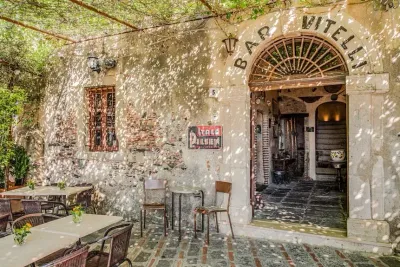
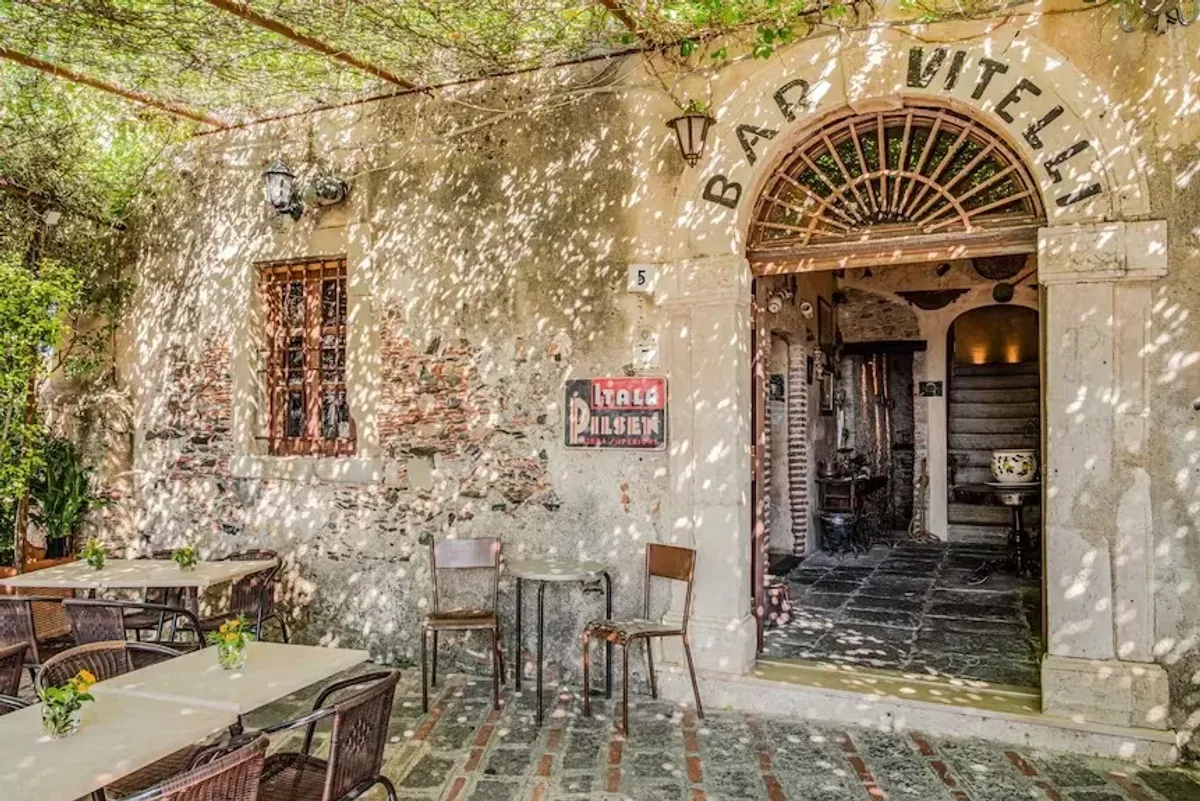
Savoca is the village where most of the Sicilian scenes are set. It’s here that Michael Corleone, exiled in Sicily after the attempt on his father’s life, falls in love with Apollonia. The most visited location is Bar Vitelli, on Piazza Fossia: the bar where Michael formally asks Apollonia’s father for her hand, inside the 18th-century Palazzo Trimarchi. The venue didn’t even have an official name before the film — today it looks almost identical to 1971, with the same panoramic terrace over the valley.
Forza d’Agrò: the wedding
A few minutes from Savoca, Forza d’Agrò provided the backdrop for Michael and Apollonia’s wedding scene, shot on the church forecourt. It’s a medieval hilltop village with narrow lanes and, on clear days, views stretching from the Ionian coast to Mount Etna.
An itinerary through both villages
Savoca and Forza d’Agrò are about ten minutes apart by car, and can both be visited in the same afternoon starting from Taormina, roughly 30 minutes further south. In Savoca, besides Bar Vitelli, the Chiesa Madre and the belvedere over the Agrò valley are worth a stop; in Forza d’Agrò, the old town and the remains of the Norman castle.
Practical tip: Bar Vitelli is open year-round, but in the summer months it can get very busy with fans retracing the film. Always check current opening hours before setting off.
In short
The Godfather turned two small Sicilian villages into a must for film fans worldwide, without either place ever ceasing to be what it was before the film: a real, inhabited town, with a bar that still serves granita at the same tables. Discover more films and shows shot in Italy, or the full list of movie restaurants.
📍 Book where you read about it
Affiliate link: if you book through this link we may earn a small commission, at no extra cost to you.
🎟️ Live the experience
Affiliate link: if you book through this link we may earn a small commission, at no extra cost to you.
Frequently asked questions
▸ Where was the Sicilian part of The Godfather filmed?
In the villages of Savoca and Forza d'Agrò, in the province of Messina. The town of Corleone, which gives the family its name, was considered too modernised, so Coppola chose these two villages, which had remained almost untouched.
▸ Why wasn't The Godfather filmed in Corleone itself?
Because by the 1970s Corleone had changed too much from the novel's setting. The crew looked for villages with more authentic architecture and found them in the Messina area.
▸ Does Bar Vitelli really exist?
Yes, it's a real bar on Piazza Fossia in Savoca, inside the 18th-century Palazzo Trimarchi: it's where Michael Corleone (Al Pacino) asks for Apollonia's hand, and it's still open today.
▸ What's worth seeing in Forza d'Agrò related to the film?
The church and its forecourt, used for Michael and Apollonia's wedding scene, along with the village's medieval old town, perched above the Ionian coast.
📖 Need a ready-made itinerary?
The CineFood Italia PDF Guide: every real venue with address, price and 3 ready-made itineraries, $9.97.